Wednesday, October 29, 2014

"Kill The Indian And Save The Man."


In 1879, a man by the name of Richard H. Pratt decided to open a boarding school for Indian Children in Carlisle, Pennsylvani.  His goal was to use education to teach Indian children "the ways of the white man. That year, 50 Kiowa, Cheyenne and Pawnee children showed up on Pratt's door.  Pratt cut their hair, required them to only speak English, and it clear that there were to be no displays of tribal traditions, such as Indian apparel, dances, or religious performances.  "Kill the Indian and save the man," was Pratt's motto.  His school became a model for Indian education.  Soon, more schools were established.  The schools' goals were to teach Indian children the means required to make their way in the American Society.  In doing so, they ended up stripping the young Indian generation of their cultures, heritage and person legacies.
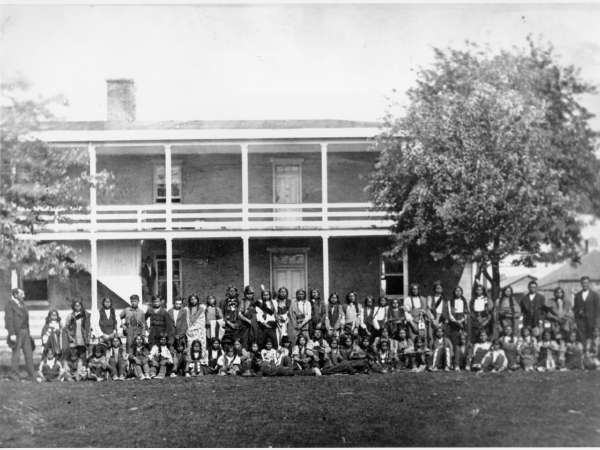
Sioux Boys As They Were Dressed On Arrival at the Carlisle Indian School, Pennsylvania 10/5/1879
(Sioux Boys As They Were Dressed On Arrival at the Carlisle Indian School, Pennsylvania 10/5/187) -Source: Digital History, digitalhistory.uh.edu

Tuesday, October 28, 2014

The Battle Of Wounded Knee II


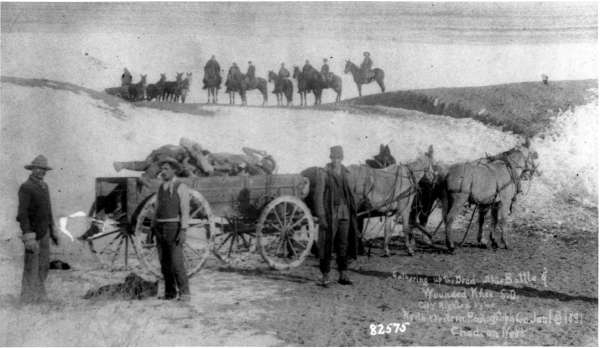
On December 29th, 1890 at the location Wounded Knee Creek, the Indians were ordered to give their arms.  Someone fired a gun, and this action led to the deaths of over 200 Indian men, women and children.  They were killed by machine guns, fired by the U.S. Army soldiers.  For their actions at Wounded Knee Creek, they received 22 Congressional Medals of Honor.  Among the dead bodies upon the bloody snow, was found a four month old Lakota infant named Zintkala Nuni, who lay under her dead and blood stained mother.  Zintkala Nuni and 47 other women and children were taken away alive, but mostly wounded.  A man by the name of General Leonard Colby and his wife Clara took the Lakota in and raised her as their own, renaming her Marguerite.  She later died at the age of 29.

A man named General Nelson Miles, who commanded military forces in that area, sought out a court martial for the office in charge of the soldiers at Wounded Knee.  He described what happened as a "Cruel and unjustified massacre," and I happen to agree with him.

"The whites, by law of conquest, by justice of civilization, are the masters of the American continent and the best safety of the frontier settlers will be secured by the total annihilation of the few remaining Indians."  -L. Frank Baum, editor and publisher of the Saturday Pioneer, also the author of the popular and much beloved, The Wonderful Wizard Of Oz. 


Gathering Up the Dead at the Battlefield of Wounded Knee, South Dakota
"Gathering Up the Dead at the Battlefield of Wounded Knee, South Dakota, 1890."


Wednesday, October 1, 2014

THE GILDED AGE: The Homestead Act

Today I read about the Homestead act, which was "to encourage farmers to settle on the Great Plains." (Digital History, The Homestead Act.

I also read the biography of Grover Cleveland.

Friday, August 29, 2014

Sharecropping

What the freed men and women wanted above all else was land on which they could support their own families. -Digital History


Thursday, August 28, 2014

Emancipation in Comparative Perspective

After the slaves had been granted their freedom, they took advantage of every opportunity they encountered. They set up their own newspaper office, insisted on being called "miss" or "mister" and brought about their own church services.  But the whites did not like this dramatic change.  Some whites persecuted, mistreated and even murdered the ex-slaves.

Monday, August 25, 2014

Birth of a nation

Birth Of A Nation, the first blockbuster of the silent films was created by D.W. Griffith in 1915.  It is a little over three hours long, so I just watched a couple minutes of it. The full movie is on youtube.

Friday, August 22, 2014

reconstrucition: reuniting the union

Reading about the Reuniting of the Union made me realize how much more went on through the process. I did not think there were so many steps to making the reconstruction possible. People,suffered, people agreed and disagreed. There were riots and fights, some people were even killed. There were allot of sacrifices made to reunite the union.

Thursday, August 21, 2014

The First Americans.

When Columbus came to America, he did not find empty lands waiting for people to inhabit them. There were already tenants living and improving these lands, known as the Native Americans. The Native Americans were considered the first Americans. They were not as advanced as the Europeans that they were to encounter later on. They did have the wheel, but it was used as a toy. They had no knowledge of guns, swords, gun powder or diseases such as influenza or the measles.  The Native Americans were involved in agriculture and hunting. They grew their own food, and hunted for an other means of nourishment. There was not only one kind of Native living in what we call now, the US. There was over 2,000 different languages being spoken, and there were different kinds of tribes with different cultures then the others. There might have been differences in, for example, religions or hobbies.

Tuesday, August 19, 2014

Lesson One: Revolutionary Mindset And The American Revelution

"There was hope and fear, vision and desperation," among the people during the Revolutionary era.  There was a willingness to risk everything, for the rights of Liberty, Life and Property.  When the people felt as if there was a sense of injustice or unfairness, they rose up and requested a change. Change was not granted, so they fought for the change they wanted to see. People took great risks to earn their rights, and families split over opinions.  A friend became an enemy, a family member became a stranger. To achieve their victory, they had to endure heart ache and loss. The people were knee deep in English tradition. It was time for a change, and they sought it out until the attained it.